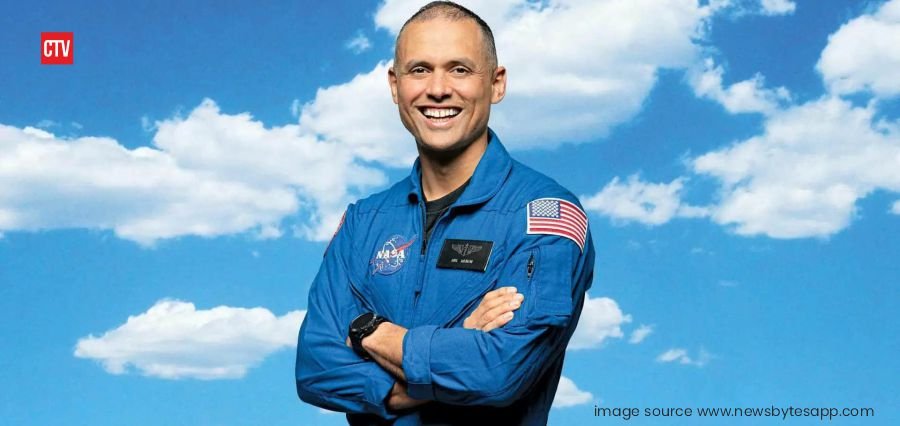
NASA astronaut Anil Menon is scheduled to launch to the International Space Station (ISS) on July 14, marking his first mission to space and an important milestone in his distinguished career as a physician, engineer, and astronaut. Menon will travel aboard the Soyuz MS-29 spacecraft from the Baikonur Cosmodrome in Kazakhstan alongside Roscosmos cosmonauts Pyotr Dubrov and Anna Kikina for an approximately eight-month mission aboard the orbiting laboratory.
During his mission, Menon will serve as a flight engineer for Expeditions 74 and 75, contributing to a wide range of scientific investigations focused on human health, advanced technologies, and long-duration space exploration. His work is expected to support future missions to the Moon and Mars while expanding scientific knowledge in medicine, biology, and materials science.
Mission Focuses on Space Research and Human Health
Over the course of the mission, Menon and his fellow crew members will conduct experiments examining how extended exposure to microgravity affects the human body. Researchers hope these studies will improve understanding of bone loss, muscle deterioration, cardiovascular health, and other physiological changes experienced during prolonged spaceflight. The findings will help scientists develop countermeasures for astronauts participating in future deep-space missions.
The crew will also evaluate new medical technologies and healthcare systems designed for use in space, supporting efforts to provide advanced medical care during long-duration missions beyond low Earth orbit. In addition, scientific investigations aboard the ISS will include research into semiconductor crystal production and other materials science experiments that could contribute to advances in computing, electronics, and medical devices on Earth.
Alongside scientific research, the astronauts will perform routine maintenance, technology demonstrations, and operational activities that ensure the continued functioning of the International Space Station as one of the world’s leading space research laboratories.
From Physician to Space Explorer
Before joining NASA’s astronaut corps, Menon built an accomplished career spanning medicine, engineering, military service, and commercial spaceflight. He served as an emergency medicine physician, a U.S. Air Force flight surgeon, and later became SpaceX’s first flight surgeon, supporting multiple human spaceflight missions before being selected as a NASA astronaut in 2021.
His diverse background has provided expertise in aerospace medicine, human performance, and astronaut health, making him well suited for missions involving complex scientific research and long-duration human spaceflight. Following two years of intensive astronaut training, Menon was assigned to Soyuz MS-29, his first orbital mission.
The international crew reflects continued cooperation in space exploration, with astronauts and cosmonauts from multiple countries working together to advance scientific discovery despite broader geopolitical differences.
Advancing the Future of Space Exploration
The International Space Station continues to serve as a critical platform for scientific research that benefits both space exploration and life on Earth. Experiments conducted aboard the station contribute to advancements in medicine, biotechnology, robotics, agriculture, and engineering while helping scientists prepare for future missions beyond Earth’s orbit.
Menon’s mission also highlights the growing contributions of astronauts with multidisciplinary expertise, combining medicine, engineering, and operational experience to address the challenges of human spaceflight. His research is expected to generate valuable insights that will support NASA’s long-term exploration goals, including sustained lunar missions and eventual crewed journeys to Mars.
As the July 14 launch approaches, the mission represents another important chapter in international space collaboration and scientific innovation. By conducting cutting-edge research in orbit, Menon and his fellow crew members will contribute to discoveries that could improve healthcare, technology, and human space exploration for years to come.
Read More: Anthropic Expands Claude Cowork to Mobile and Web for Seamless AI Task Management