
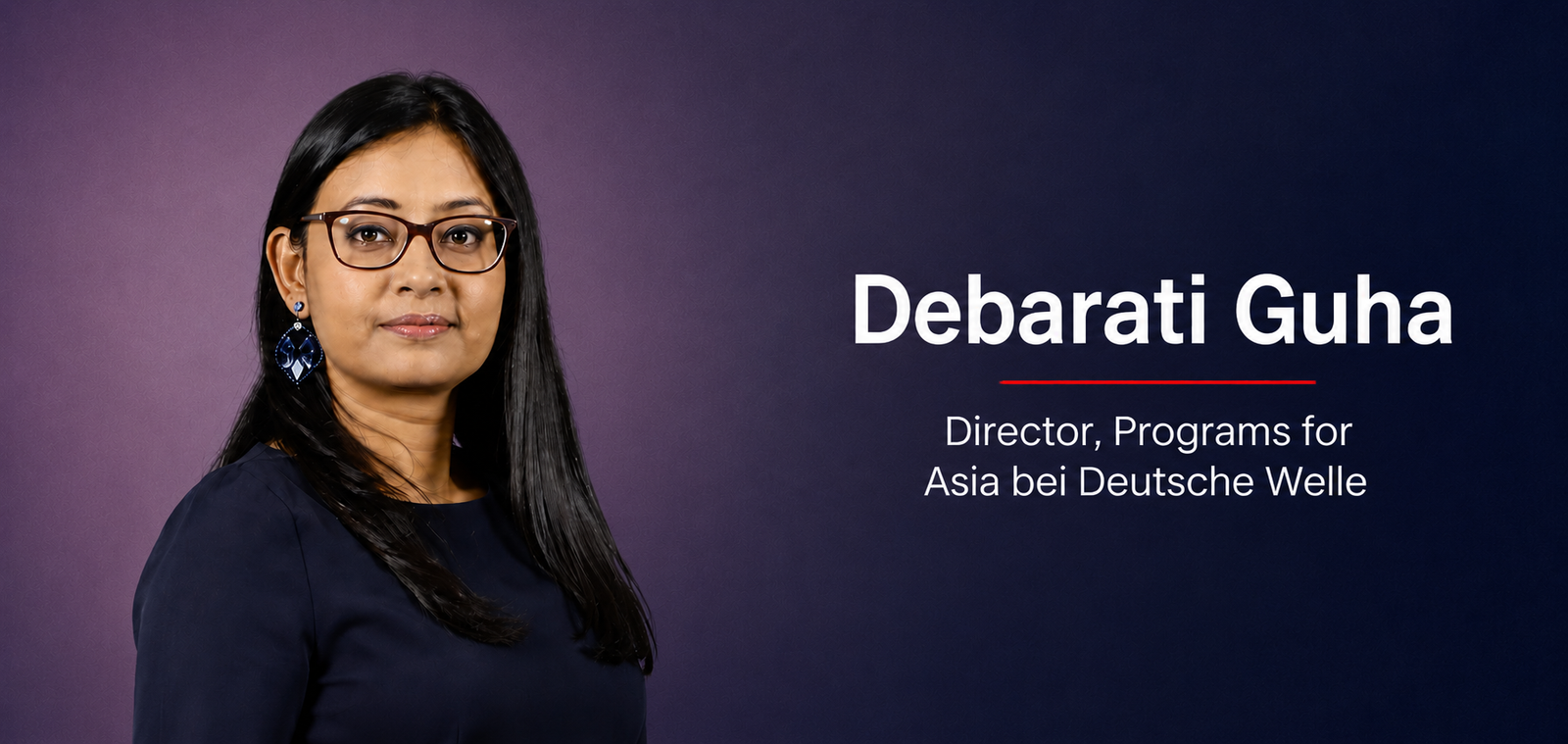
Author: Debarati Guha, Director, Programs for Asia bei Deutsche Welle
The global debate on artificial intelligence is dominated by familiar actors. Silicon Valley builds platforms. China advances state-led AI development. Europe responds with regulation.
Yet one of the most important questions in the AI era receives remarkably little attention:
Who gets protected from disinformation, and in which language?
As generative AI dramatically lowers the cost of producing convincing falsehoods, concerns about deepfakes, synthetic media and election interference continue to grow. But the risks of AI-driven disinformation are not distributed equally.
An English-speaking user typically encounters platforms with far more sophisticated moderation systems, larger fact-checking networks, and greater safety investments than users communicating in Bengali, Burmese, Tamil, Nepali or dozens of other languages spoken across South and Southeast Asia.
This creates an accountability gap that may become one of the defining challenges of the AI age.
Technology is global. Accountability is not.
A Global Technology with Unequal Protections
Today’s digital landscape is shaped by three dominant power centers.
The United States leads through private-sector innovation and the enormous investments of its technology companies. China has built a state-centric digital ecosystem in which AI development closely aligns with political and economic priorities. Europe has sought influence through regulation, most notably the Digital Services Act and the AI Act.
Many countries in South and Southeast Asia operate within frameworks largely designed elsewhere. Their citizens use global platforms, generate vast amounts of data, and increasingly rely on AI-powered services. Yet they exercise limited influence over how these systems are governed or moderated.
As AI tools become embedded in public discourse, elections, education and commerce, this imbalance matters.
Technology crosses borders effortlessly. Mechanisms of accountability do not.
Why Disinformation Scales So Well
Disinformation thrives because it aligns remarkably well with the economics of the modern internet.
Platforms monetize attention. Engagement generates revenue. Content that provokes outrage, fear or strong emotional reactions often performs better than nuanced reporting or verified information.
Generative AI accelerates this dynamic.
What once required coordinated networks of actors can now be produced by a handful of individuals using inexpensive AI tools. Images, videos, voices, and entire news stories can be fabricated within minutes and distributed at unprecedented scale.
Verification remains much slower.
It depends on journalists, researchers, fact-checkers and citizens willing to investigate claims, compare sources and establish context.
Falsehoods can increasingly be produced at industrial scale, while truth remains largely handcrafted.
The Language Divide Is Also a Trust Divide
The greatest vulnerability may not be technological. It may be linguistic.
Platform companies often describe their products as global. Their safety investments, however, are not.
Content moderation resources continue to be concentrated disproportionately in a small number of major languages, particularly English. Yet many of the world’s fastest-growing digital populations communicate in languages that receive far fewer resources.
This is not simply a translation problem.
Disinformation is highly contextual. Political narratives, historical grievances, local humor, religious references, and coded language often require deep cultural knowledge that automated systems struggle to understand.
The consequences are already visible.
Myanmar remains one of the starkest examples. In 2018, a United Nations Fact-Finding Mission concluded that Facebook had played a determining role in spreading hate speech against the Rohingya population and that the platform had failed to prevent the amplification of inflammatory content. The case demonstrated how weak moderation in local languages can contribute to real-world harm.
The problem extends beyond Myanmar. During India’s 2024 general election, AI-generated deepfakes of politicians circulated widely across social media platforms and messaging services, raising concerns about manipulation at an unprecedented scale. Indonesia’s 2024 election similarly highlighted the growing role of synthetic content and digitally amplified misinformation in political campaigning.
Generative AI makes these challenges even more difficult to address. Content can now be adapted instantly across multiple languages, dialects, and formats.
When moderation systems fail in local languages, trust becomes unevenly distributed.
Some citizens receive stronger protection against manipulation than others simply because of the language they speak.
That should concern policymakers, regulators, and technology companies alike.
Journalism Cannot Solve This Alone
Independent journalism remains one of society’s most effective defenses against organized disinformation.
Professional reporting is built on verification, transparency, and accountability. These remain indispensable values in an age of synthetic media.
Yet journalism cannot solve a problem created by incentives far larger than any newsroom.
No media organization can consistently outcompete recommendation systems optimized to maximize engagement rather than accuracy. Fact-checking remains essential, but correcting falsehoods after they have gone viral is increasingly a defensive strategy.
The challenge extends beyond journalism.
Teachers, researchers, civil society organizations, technology companies, policymakers, and citizens all have a role to play in building resilient information ecosystems.
From Voluntary Commitments to Measurable Accountability
Calls for better moderation and greater responsibility are no longer enough.
The priority should be transparency.
First, platforms should be required to publish language-by-language data on safety investments. How many moderators support each language? How quickly are harmful posts reviewed? What resources are dedicated to elections, hate speech and misinformation? How do those investments compare with the size of the user base?
Without transparency, neither regulators nor the public can determine whether protection is being distributed fairly.
Second, governments should require large platforms to demonstrate that safety investments are broadly proportional to the audiences they serve.
A platform with one hundred million Bengali-speaking users should not be allowed to devote only a fraction of the resources allocated to a significantly smaller English-speaking audience.
Such disclosures could take the form of independently audited language-equity reports, allowing regulators, researchers, and citizens to assess whether platform safeguards are being distributed fairly across linguistic communities.
Third, any discussion about regulation must acknowledge an uncomfortable reality.
States themselves are often actors in the disinformation ecosystem.
Across the world, including parts of Asia, anti-disinformation laws have sometimes been used not only against false information but also against journalists, political opponents, and critical voices. In several countries, governments have simultaneously positioned themselves as defenders against disinformation while actively shaping information environments for political purposes.
The challenge is therefore not merely building regulatory capacity. It is ensuring that regulatory institutions themselves remain independent, transparent, and subject to democratic oversight.
The challenge is not simply how to regulate platforms.
It is how to build accountability without creating censorship.
There is no universal formula. Different societies will draw the boundaries between freedom of expression and protection from harm differently. But any serious debate must acknowledge that tension rather than ignore it.
Building Capacity Where It Matters
The response to AI-driven disinformation must also include investment in people.
Digital literacy should be understood as more than access to devices or internet connections. Citizens need to understand how recommendation algorithms shape information consumption, how AI-generated content is produced, and how sources can be verified.
Critical thinking, source evaluation, and basic media literacy are becoming democratic necessities.
South and Southeast Asia should also invest more heavily in local-language AI research, fact-checking networks, and public-interest technology. Dependence on imported technologies inevitably limits the ability to shape outcomes.
The issue is not technological isolation.
It is ensuring that local realities, languages, and democratic needs are reflected in systems that increasingly influence everyday life.
Looking Beyond the AI Race
Much of today’s discussion focuses on who will win the AI race.
A more important question is whether the benefits and protections of AI will be distributed fairly.
For policymakers, the greatest challenge may not be artificial intelligence itself but the growing inequality in how digital safeguards are applied across languages, societies, and regions.
If users speaking English receive one level of protection while users speaking Bengali, Burmese or Tamil receive another, then AI risks reinforcing existing global inequalities rather than reducing them.
Technology is global. Accountability is not.
The question facing South and Southeast Asia is therefore not whether AI will shape the future. It already does.
The real question is whether billions of people will help shape the rules governing AI or simply live with decisions made elsewhere.