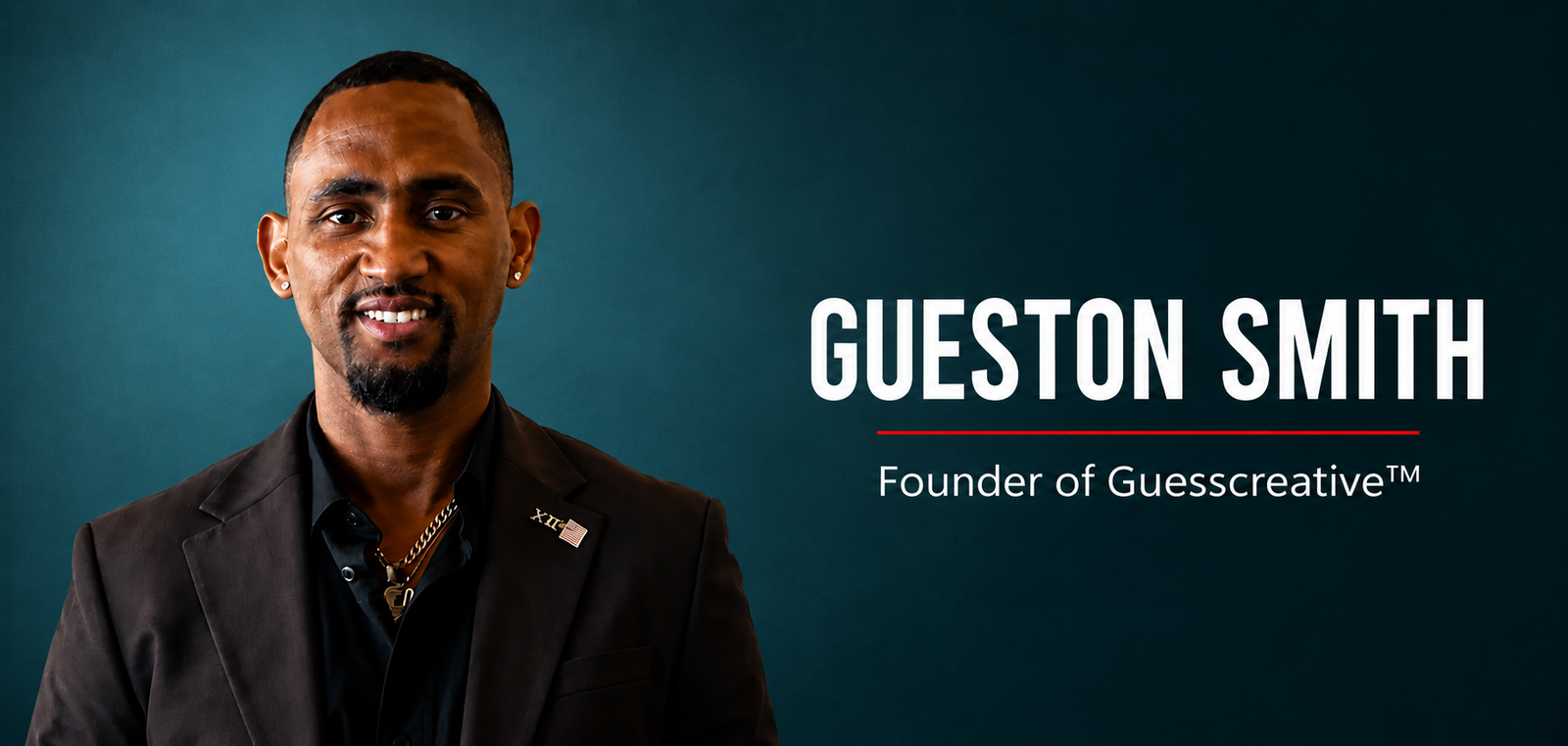
Author: Gueston Smith, Founder, Guesscreative™
Capability is decentralizing.
Communication has moved beyond the landline. Work has moved beyond the office. Finance, retail, media, education, and information now move through networks that did not exist a generation ago.
But the way we use physical space has not caught up.
Many businesses, institutions, and community programs still operate under the assumption that opportunity must be delivered through centralized facilities. A student must travel to class. A founder must rent a storefront. A customer must come to the showroom. A patient must reach the clinic. A community must travel to the resource.
That model works for people with transportation, capital, time, proximity, and access. It works less effectively for people and organizations without those advantages.
This is not only a real estate problem. It is a design problem.
When opportunity depends too heavily on fixed locations, access becomes filtered by distance, leases, zoning, buildout costs, transportation barriers, and the luxury of waiting. The constraint is so normalized that many people no longer see it. We have been trained to treat fixed space as the default setting for legitimacy, service, learning, commerce, and growth.
But fixed space is not the only model.
This is the point of Spatial Entrepreneurship: space can be treated as a movable asset that distributes capability where it is needed.
Spatial Entrepreneurship is the mindset and strategy of building a business, program, or service inside a deployable environment that can be owned, moved, adapted, and replicated. Instead of treating space only as a fixed address, it treats space as an operating asset.
A trailer, shipping container, bus, modular pod, expandable unit, or mobile studio is not the innovation by itself. These structures are not new. The deeper shift is what they make possible when designed with a clear business model, user experience, and deployment strategy.
A movable space can become a retail store, classroom, wellness suite, jobsite office, training lab, content studio, showroom, clinic, hospitality unit, or community resource hub. The form may vary, but the principle stays the same: define the capability, design the environment, and move that capability toward demand.
For entrepreneurs, this challenges one of the oldest assumptions in business: that legitimacy requires a permanent storefront.
A fixed location can be powerful, but it can also become a constraint. Long leases, high overhead, slow buildouts, zoning friction, and sunk tenant improvement costs can limit experimentation before a business has truly validated its market. Many founders spend years building someone else’s equity through rent before they own a meaningful physical asset.
Deployable environments flip that model.
They allow operators to own instead of rent, test markets before committing permanently, follow customer concentration, activate events, reach underserved areas, and scale through repeatable units. The asset can move with the business. It can be upgraded, refinished, rebranded, leased, sold, redeployed, or replicated.
That changes the relationship between space and wealth. The environment is no longer only an expense. It becomes part of the operating system.
At Guesscreative, I describe this as ownership in motion.
The first principle is Ownership Architecture. Business owners should think about space as something they can own, move, and build equity through. A well-designed mobile unit is not just a container for activity. It is a branded asset, a customer experience platform, and a piece of physical infrastructure that can compound in value through use, visibility, and replication.
The second principle is Mobility Strategy. A business does not have to wait for customers to discover a fixed location. It can deploy where attention, need, and demand already exist. That might mean a wellness pod in a neighborhood, a mobile showroom at a festival, a training trailer at a jobsite, a learning lab on a school campus, or a retail unit positioned near seasonal foot traffic.
The third principle is Experiential Autonomy. Space shapes perception. When someone enters a business environment, they are not only seeing products or services. They are sensing the brand. Light, sound, texture, layout, temperature, signage, sequence, and movement all shape memory. A movable space gives the operator control over that experience without depending on the limitations of a leased shell.
This is why Spatial Entrepreneurship extends far beyond food trucks or pop-up shops. Those are familiar examples, but they are not the ceiling. The larger opportunity is deployable infrastructure: physical environments designed to carry capability across geography.
For business and technology leaders, this creates a new kind of infrastructure question.
If software, data, communication, and work are already distributed, why should every physical capability remain tied to one permanent address?
Deployable environments can operate as physical edge infrastructure. They bring services, technology, training, commerce, and engagement closer to the people and markets they are meant to serve. A mobile training lab can extend workforce development across multiple sites. A deployable showroom can test regional demand before permanent expansion. A field office can support operations where teams are actually working. A mobile learning environment can bring specialized tools to schools that could not independently fund a permanent lab.
This matters because the future of infrastructure is not only about where an organization builds. It is about how quickly it can deploy, learn, adapt, and redeploy.
The deeper economic advantage is optionality.
A fixed buildout asks the operator to make a major commitment before the market has fully spoken. A deployable asset can reverse that sequence. It can serve first, learn first, adapt first, and then use real-world evidence to decide whether to replicate, relocate, or invest permanently.
This makes movement a form of intelligence.
Each deployment can reveal who participates, what people ask for, where demand is strongest, what operations need improvement, which partnerships matter, and what locations create the highest return. Over time, the business owner or institution is not only generating revenue or engagement. They are collecting spatial intelligence.
That intelligence can guide expansion. It can reduce risk. It can inform whether a permanent location is justified. It can also prove that permanence is not always necessary.
But mobility is not magic.
A movable unit without an operating model is just equipment. To become infrastructure, it needs scheduling, staffing, power, climate control, storage, maintenance, safety, accessibility, insurance, host-site agreements, signage, setup procedures, technology planning, and a clear deployment strategy. The asset and the operation must be designed together.
This is where many mobile concepts fail. They focus on the unit but neglect the system around it. A beautiful trailer that cannot be deployed consistently is not a business asset. It is a stranded prototype.
Spatial Entrepreneurship requires a more complete question. Not simply, “What should the unit look like?” but, “What capability are we delivering, who needs it, where should it go, how will it operate, what data should it generate, and how can it be repeated?”
That question opens a new category of business thinking.
The future will not belong only to companies with the largest buildings. It will belong to operators who understand which capabilities should stay fixed, which should move, and how both can work together.
Fixed space creates stability. Deployable space creates circulation. One anchors. The other extends. One provides continuity. The other creates reach, testing, access, and movement.
Together, they form a more adaptive model for commerce, education, wellness, culture, and community infrastructure.
This is the future I am building toward through Guesscreative: a world where entrepreneurs, brands, schools, and communities are not limited by static assumptions about space.
Your business should be able to move with opportunity.
You should be able to own the environment, control the experience, test the market, reach the audience, and replicate what works.
Mobility wins. Ownership compounds. Opportunity rewards those who can move.
Author Bio
Gueston Smith is the founder of Guesscreative, a deployable infrastructure studio designing mobile learning environments, commercial activation systems, wellness spaces, jobsite offices, and modular business assets. His work centers on Spatial Entrepreneurship: the idea that owned, deployable space can expand access, reduce overhead, create opportunity, and become a new business asset class. Learn more at www.guesscreative.com