
Being THE LEADER AS AUTHOR of your own script
There is a question I often invite leaders to consider:
Do you think you show up as the leader you intend to be?
It is a deceptively simple question.
People in positions of leadership have good intentions. They want to communicate clearly, build trust, develop their people, and make contributions that have value. Sometimes the distance between intention and impact expands, and the leadership loses its momentum. Something gets lost.
A common flaw? A leader may intend to empower but unintentionally creates dependency. They may intend to be decisive but be perceived as dismissive. They may believe they are communicating clearly, but their team members find themselves needing to read between the lines.
This is what I call the gap between intention and impact.
Closing the Gap
And that gap can happen when your leadership blueprint is based on someone else’s approach. My work as a Leadership Empowerment Coach and Inner Executive Strategist™ is centered on helping leaders recognize that gap—create their own blueprint and then do something meaningful with what they discover.
Because leadership development isn’t about filling a position. It isn’t about taking over the helm following yesterday’s pattern.
It is about becoming more fully yourself as a leader. It’s about going from performing leadership to owning it. It’s about building the foundation of your leadership yourself. I know because I have lived it.
At the time of the pandemic and in a space away from corporate activity, I was invited to step into a leadership role that had been shaped by its international membership over the course of decades. It was not an easy decision to make. How could we carry on and hold our group together when on-site meetings were suddenly taboo? We needed a new way of being. I needed a new way of leading. Initially, in doing so, I would not only have to follow the rules of engagement dictated by the history of the group (the comfortable rut) but also the uncomfortable pandemic rules of assembly needed to protect the health, mentally and physically, of the members wanting to have opportunities to collaborate.
Clearly, going forward, the tried-and-true practices of previous leaders were not going to work. I needed a new blueprint. If I was going to lead, I needed to build my own blueprint…one that I believed I had the power to implement. Long story short, I accepted the challenge, and I am pleased to report that my leadership drew a dramatic increase in attendance over the years that followed.
In an environment where members showing up was completely at their discretion, my experience taught me that leadership can be successfully blueprinted according to personal vision. It taught me that leadership practiced with a high degree of consistency, responsiveness, and respect made a difference to those I served. For instance, my attention paid to routine housekeeping matters like starting on time and ending on time paid huge dividends in terms of trust.
I fully believe that we are offered opportunities that are meant to give us experience and insight. They shape us and mold us as we transition. Over more than two decades of coaching executives, entrepreneurs, and emerging leaders, as well as being in personal leadership roles, my philosophy about leadership has evolved. Early in my career, I was focused on helping people define their role. Today, I focus much more deeply on alignment—the alignment between who a leader is, what they value, how they communicate, the outcomes they want to achieve, and how they are experienced by others.
The most powerful leadership transformation often begins when someone stops asking, “What should I do?” and starts asking, “What is true for me?” That distinction matters.
Books on leadership are filled with models, formulas, and advice about how successful leaders are supposed to play the part. While it is a good idea to be familiar with what authors have to say on the subject, you could be uncomfortable following someone else’s formula and thereby lose sight of your own leadership voice. It’s like trying to act a part that does not fit you.
Exceptional leaders eventually discover that their uniqueness is not something to be overcome. It is something to be understood and developed. Don’t let your uniqueness be your blind spot. Allow it to enter the spotlight.
I did just that when I wrote Lessons I Learned from the Tortoise. I found 22 lessons that could be paired with Aesop’s fable. Life lessons. Everyday stuff. The reviews on Amazon have given me significant feedback as to the value within the covers. And my readers have taught me that my written work has the capability of being the coach when I am not even in the picture. How rewarding! Being self-published has its challenges. I am pleased to share that one reviewer wrote, “This is an insightful, well-written book which delivers on the promise in the subtitle: ‘Reflections on speed, tenacity and competition in life and business.’”
Testimonials for my work both as a coach and as an author are part of being in the spotlight. They include words like catalyst for success, coach’s coach, insightful, practical, and inspiring. I consider these descriptors as high praise indeed.
And I want the spotlight for you as a leader, too.
Blind spots and Spotlights
Blind spots limit. Blind spots block. They close doors and slam them shut. One of the greatest leadership blind spots is assuming that good intentions automatically produce good impact.
They don’t.
They can isolate you. And the solution isn’t in getting defensive. It is in being open and curious. It’s about finding the space that holds your courage and letting it be present as you learn what’s needed and make the shift.
After years of being bullied in public school, I allowed the part of me that was the victim to dominate my courage. My courage virtually left the building. No courage meant no need to engage…in anything!
Authorship helped me dissolve the victim mentality that did not serve me and helped me rise through exposing what I knew in print. As an author, I could employ my voice without making a single sound. It all began with a magazine publisher who invited me to write an article and a challenger who dared me to expand the article into a book. That was book number one. There are now six books.
Spotlight on the Leader as Author
This brings me to an idea that has become increasingly important in my work:
Leaders are not here to re-enact someone else’s story. Leaders need to become the authors of their own leadership journey.
Every leader has a story. I invite you to be the author of your own story.
Some of your story was written before you ever held a leadership position. It includes family influences, early experiences, mentors, failures, successes, and assumptions about what leadership is supposed to look like.
Eventually, we have to decide which parts of that story we want to carry forward—and which parts we are ready to rewrite.
Are you ready to step into your own leadership story and work at cutting, shifting, incorporating, introducing, and evolving your role as leader?
I launched my coaching practice the very same day I launched my first book. To the business community, I was a nobody. If I was going to step into a consulting role, I needed to have authority. Authoring a book that related to improving the chances for success as an entrepreneur gave me that foundation.
In my coaching sessions, I have often found myself showing leaders that they carry far more wisdom than they realize. The lessons they learned through difficult decisions, pivotal moments, failures, reinvention and success may be exactly what another leader needs to hear.
Your experience can become someone else’s roadmap. You go from being the expert to becoming the catalyst.
My work with leaders like Dr. Suhayya Abu-Hakima and Betty Carew as they wrote their books is tangible evidence that leadership manifested as authorship can deliver that roadmap.
In closing
The more technologically sophisticated our workplaces become, the more important distinctly human leadership becomes.
I believe the future of successful coaching and leadership will be ever-increasingly based on its human characteristics, even as the workplace becomes more high-tech.
Leaders will need to know not only how to use technology, but how to create environments where people feel seen, heard, challenged, and valued.
So, what is your next chapter?
Perhaps this is the question I would most like to leave with leaders.
Not How can I become a better leader?
But:
What kind of leader am I becoming—and what do I want my leadership to stand for?
There may be a leadership philosophy inside you that you have never articulated.
There may be lessons you have learned that could help others.
There may be a book inside you.
Or perhaps you simply know that the way you have been leading no longer reflects who you are becoming.
None of those realizations requires an immediate answer.
They require exploration.
That is where meaningful leadership transformation begins.
Sometimes the next chapter doesn’t require another leadership formula.
Sometimes it requires the courage to look inward, recognize what is uniquely yours and begin writing from there.
I don’t want to create leaders who sound like me.
I want to help create leaders who sound unmistakably like themselves.
And perhaps that is one of the most important leadership journeys any of us can undertake.
About Donna P. Dahl
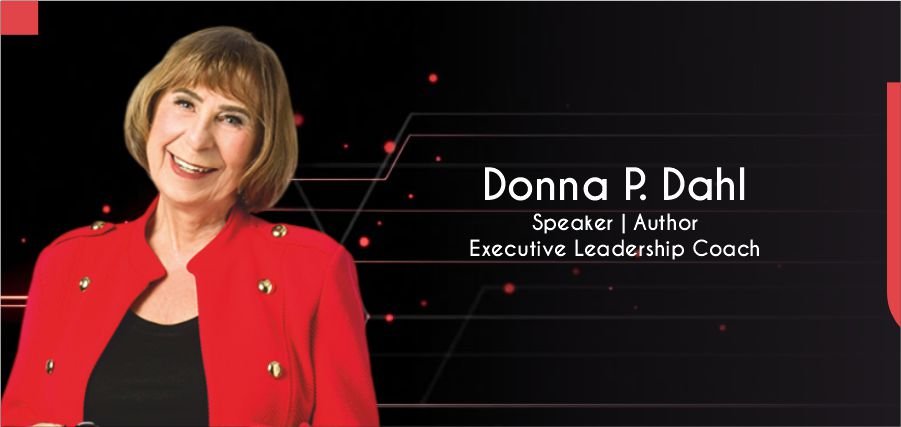
Donna P. Dahl is a Leadership Empowerment Coach, Inner Executive Strategist™, speaker, and author who helps leaders close the gap between how they intend to lead and how they are actually experienced. Drawing on more than two decades of coaching experience, her work focuses on leadership alignment, communication, trust, empowerment and the development of authentic leadership influence. She is the creator of the C.O.R.E. Coaching Method™, the founder of The Leadership Alignment Index and the author of Lessons I Learned from the Tortoise. Her keynote address, The Challenger’s Gift, has its foundation in her Tortoise book.
Website: DonnaPDahl.com
LinkedIn: https://linkedIn.com/in/DonnaDahl